Johnston, Matthew et al. “Antibacterial activity of Manuka honey and its components: An overview.” AIMS microbiologyvol. 4,4 655-664. 27 Nov. 2018, doi:10.3934/microbiol.2018.4.655
The Science
Nature's Most Powerful Honey.

The Science Behind
Nature's Most Powerful Honey
More than a decade of scientific research has demonstrated that Ulmo honey exhibits the highest antibacterial properties, surpassing even those of Manuka honey¹.
Phenolic Content
2×
More than double the phenolic content of Manuka Honey.
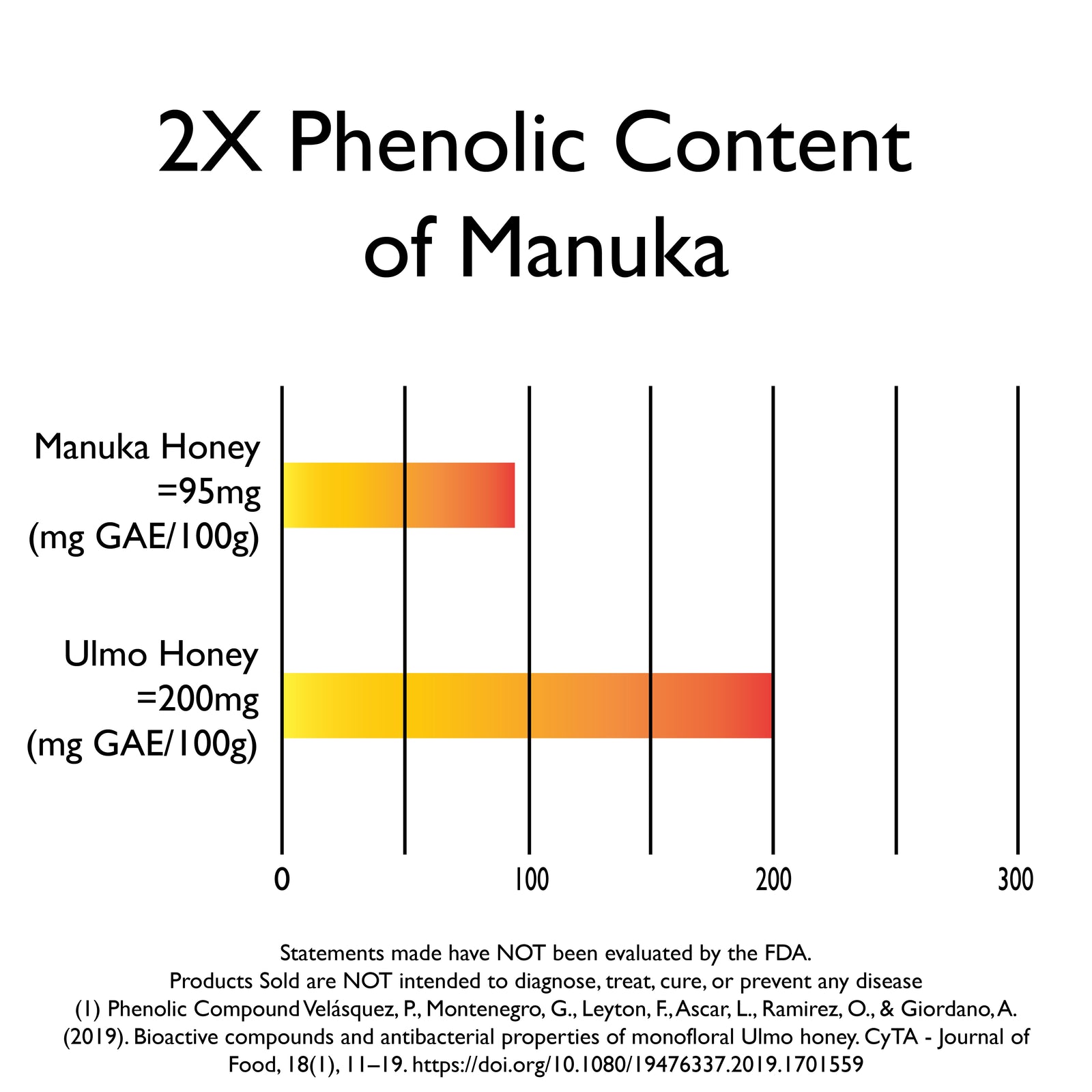
Ulmo Honey contains more than double the phenolic content of Manuka honey. Known to promote anti-inflammatory, antioxidant and immunity-boosting activity in our bodies, these heavily studied health-promoting molecules are unmatched in our Ulmo Honey.
Powerful Complex of
Bioactive Ingredients
Polyphenols and flavonoids — antioxidant, anti-inflammatory, and anti-bacterial.
Tested vs Manuka
Antibacterial
Similar or stronger antibacterial properties against five strains of MRSA, E. coli, and P. aeruginosa.
Scientific CompilationDaily Superfood
Something Sweet to Feel Great About!
Raw honey leaves pollen and propolis, packed with essential nutrients, including trace vitamins and minerals and bioactive enzymes, making it a superior choice over any sweetener.
Use it as your daily energy and health booster, pre workout, sweetener of choice for your favorite beverages, as a topping for just about anything, or simply a spoonful straight from the jar.
Our Ulmo Honey is a unique and natural superfood, we recommend a spoonful a day on an empty stomach for better absorption.
Citations
Velásquez, P. et al. (2019) "Bioactive compounds and antibacterial properties of monofloral Ulmo honey", CyTA - Journal of Food, 18(1), pp. 11–19. doi: 10.1080/19476337.2019.1701559.
Sherlock, O., Dolan, A., Athman, R.et al. "Comparison of the antimicrobial activity of Ulmo honey from Chile and Manuka honey against methicillin-resistant Staphylococcus aureus, Escherichia coli and Pseudomonas aeruginosa". BMC Complement Altern Med10, 47 (2010). https://doi.org/10.1186/1472-6882-10-47
Velásquez, Patricia, et al. "Bioactive compounds and antibacterial properties of monofloral Ulmo honey". CyTA-Journal of Food18.1 (2020): 11-19
Poulsen-Silva, Erick et al. “Antimicrobial, Antioxidant, and Anti-Inflammatory Properties of Monofloral Honeys from Chile.”Antioxidants (Basel, Switzerland)vol. 12,9 1785. 21 Sep. 2023, doi:10.3390/antiox12091785
